Mark Twain What You Know That Aint So
Mark Twain? Josh Billings? Artemus Ward? Kin Hubbard? Volition Rogers? Bearding?
 Dearest Quote Investigator: The Oscar-winning 2015 film "The Large Brusk" begins with a display of the post-obit statement:
It ain't what you don't know that gets you into trouble. It's what you know for sure that just own't then.
The bright humorist Marker Twain receives credit, simply I have been unable to find a solid citation. This quip is very popular. Would you lot please investigate?
Quote Investigator: Scholars at the Middle for Mark Twain Studies of Elmira Higher have found no substantive evidence supporting the ascription to Marker Twain. [1] Website: Center for Marker Twain Studies, Article title: The Counterfeit Twain: "Things We Know That But Own't So.", Article author: Matt Seybold, Date on website: October 6, 2016, … Keep reading
The observation has been attributed to several other prominent humorists including: Josh Billings (pseudonym of Henry Wheeler Shaw), Artemus Ward (pseudonym of Charles Farrar Browne), Kin Hubbard (pen name of Frank McKinney Hubbard), and Will Rogers. Even so, it is unlikely then whatever of them said it. The creator remains bearding based on current evidence.
The saying is hard to trace because information technology falls within an evolving family unit of remarks concerning faulty knowledge and memory. Three processes operate on members of the family to generate new members and ascriptions incrementally:
- Statements are rephrased over time.
- Statements are hybridized together to produce new statements.
- Attributions are shifted from one prominent humorist to some other.
The family contains some comments with genuine ascriptions. For case, in 1874 a compendium of wit and sense of humor from Josh Billings was published. The work employed dialectal spelling which causes headaches for modern researchers who are attempting to find matches using standard spelling. The following pertinent detail appeared in a section labeled "Affurisms", i.e., "Aphorisms". Emphasis added to excerpts by QI: [2] 1874, Everybody's Friend, Or; Josh Billing's Encyclopedia and Proverbial Philosophy of Wit and Sense of humour, Section: Affurisms: Sollum Thoughts, Quote Folio 286, American Publishing Company, Hartford, … Continue reading
I honestly beleave information technology iz meliorate tew know nothing than two know what ain't so.
Here is the argument written with standard spelling:
I honestly believe information technology is better to know zilch than to know what ain't so.
This remark partially matched the saying nether investigation, and it acted as a seed in the evolving family of remarks.
Hither are additional selected citations in chronological order.
Billings died in 1885, and in 1899 a religious orator whose words were recorded in the pages of "The Pacific Unitarian" reassigned a rephrased version of the maxim from Billings to Twain: [3] 1899 February, The Pacific Unitarian, Volume 7, Number iv, Address of Rev. Charles R. Brown, Kickoff Page 118, Quote Page 119, Column 2, San Francisco, California. (Google Books Total View) link
Perhaps, as Marker Twain observed, information technology is improve not to know and then much than to know so many things that aren't so.
In 1900 "The Dietetic and Aseptic Gazette" printed a argument attributed to Billings with quotation marks surrounding only a segment. The full statement included the cardinal word "trouble" which occurs in the target saying: [iv] 1900 Oct, The Dietetic and Aseptic Gazette, Volume 16, Number 10, Department of Notes and Queries, Start Folio 641, Quote Folio 643, The Gazette Publishing Company, New York. (Google Books Full … Continue reading
Upon reading the first item we are forcibly reminded of the pertinent and pithy remark of the lamented humorist, Josh Billings, that the trouble with a keen many of us is "we know then many things that ain't so."
In 1909 an advertisement within a book chosen "A Drum's Story" ascribed a remark to Twain about old men and memory that contained the key give-and-take "trouble": [5] 1909, A Drum's Story: And Other Tales by Delavan S. Miller, (Advert material for the author's previous book: What Henry Haynie Has to Say in the Boston Times of D. S. Millers … Continue reading
Marking Twain in one case said that "the trouble with old men is they remember so many things that ain't so," just this book of war reminiscences is different from nigh of Twain's reminiscences.
In 1911 the well-known writer Yard. Chiliad. Chesterton implausibly ascribed to humorist Artemus Ward who died in 1867 a argument that partially matched the target: [half-dozen] 1911 October 14, The Illustrated London News, Our Notebook past K. Thou. Chesterton, Start Page 615, Quote Page 615, The International News Company, New York. (Google Books Full View) link
One of the two or three wisest sayings uttered on this ancient world was the remark of Artemus Ward, "Information technology ain't so much men's ignorance that does the damage as their knowing then many things that ain't then."
Twain died in 1910, and his friend Albert Bigelow Paine published a multi-volume biography of the luminary in 1912. Paine presented two quotations from Twain that partially matched the saying being explored: [seven] 1912, Mark Twain: A Biography: The Personal and Literary Life of Samuel Langhorne Clemens by Albert Bigelow Paine, Book 3 of iv, Chapter 239: Working With Mark Twain, Quote Page 1269, Harper & … Go along reading
"When I was younger I could call back annihilation, whether information technology happened or not; but I am getting old, and soon I shall remember only the latter."
At some other fourth dimension he paraphrased 1 of Josh Billings's sayings in the remark: "It isn't and then astonishing, the number of things that I can call back, as the number of things I tin remember that aren't so."
In 1913 "The Atlantic Monthly" credited Billings with the aforementioned statement that Chesterton ascribed to Artemus Ward in 1911: [8] 1913 July, The Atlantic Monthly, Volume 112, My Garden Beasts by Lucy Elliot Keeler, Start Page 134, Quote Folio 140, Column 2, The Atlantic Monthly Company, Boston, Massachusetts. (Google Books Full … Keep reading
One of the wisest sayings uttered on this ancient world was Josh Billings's remark, 'Information technology own't so much men's ignorance that does the damage as their knowing so many things that own't so.'
In 1915 "The Cosmic World" attributed a similar argument to Billings: [9] 1915 November, The Catholic World, Book 102, Number 608, Some Chapters in the History of Feminine Education by James J. Walsh, M.D. Ph.D., Start Page 194, Quote Page 194, Published by the Paulist … Continue reading
. . . "It is non so much the ignorance of mankind," Josh Billings said, "that makes them ridiculous, equally the knowing so many things that ain't then."
In 1917 a military book titled "The Unwritten History of Braddock's Field" included a chapter past George H. Lamb that credited Twain with a partial match containing the word "trouble": [10] 1917, The Unwritten History of Braddock's Field (Pennsylvania), Prepared past the History Commission Under the Editorship of Geo. H. Lamb for the Commemoration of the Gilded Jubilee of Braddock, … Proceed reading
Members of the committee were reminded of Mark Twain'south dictum, that the trouble with reminiscences is not that people know too much, simply that they know so many things that aren't so.
In April 1917 "The Lyceum Mag" printed another expression attributed to Twain most "old men" which contained the cardinal discussion "trouble: [11] 1917 April, The Lyceum Magazine, Book 26, Number 11, Dr. Conwell'southward Talks With Platform Workers past Russell H. Conwell (Honorary President I.50.A.), Quote Folio 26, Cavalcade 2, Chicago, Illinois. … Proceed reading
Mark Twain used to say that "the trouble with former men'southward memories is that they remember so many things that ain't then." Since I heard him say that several times I have been careful not to land annihilation unusual lest my friends should think that Marking Twain'southward arraignment is true in my case.
In 1921 a piece in "The Country Gentleman" printed a proverb ascribed to Billings: [12] 1921 Apr 16, The Country Gentleman, Where Ignorance Is Mis-: Misrepresentation and Misunderstanding Befuddle Our Revenue enhancement Laws by Harry R. O'Brien, Get-go Folio 13, Quote Page 13, Cavalcade 1, The … Continue reading
It ain't and so much people'due south ignorance that does the damage equally their knowing and so darned much that ain't so.—JOSH BILLINGS.
In 1923 B. C. Forbes founder of "Forbes" magazine wrote virtually a speech delivered by Francis H. Sisson, vice-president of the Guaranty Trust Company of New York: [13] 1923 February x, The Buffalo Evening Times, Finance and Business organisation by B. C. Forbes, Quote Page 11, Column i, Buffalo, New York. (Newspapers_com)
Last evening Mr. Sisson talked to a big gathering of Iowa editors. His theme was the oft-quoted observation of Josh Billings that "the trouble with the American people is not so much their ignorance as the tremendous number of things they know that ain't so."
In 1931 the "Ithaca Periodical-News" of Ithaca, New York printed an expression attributed to Billings that was semantically close to the target saying: [xiv] 1931 July 6, Ithaca Journal-News, "Things Which Ain't And then" By William Trufant Foster and Waddill Catchings , Quote Folio 4, Cavalcade 4, Ithaca, New York. (Newspapers_com)
Information technology ain't what a human don't know-that makes him a fool; it's the awful sight of things he knows' that own't then. Josh Billings said something of that sort, and Josh Billings knew what he was talking about.
In 1947 the "Janesville Daily Gazette" printed a close syntactic and semantic lucifer ascribed to Twain: [15] 1947 May 21, Janesville Daily Gazette, Editorial Panorama, (Filler item), Quote Page 6, Cavalcade 2, Janesville, Wisconsin. (Newspapers_com)
It ain't so much the things that people don't know that makes trouble in this globe, as information technology is the things that people know that own't so. — Marker Twain.
In 1958 the character Abe Martin received credit for a saying within this family. Cartoonist Kin Hubbard was the creator of Abe Martin: [16] 1958 March 5, San Francisco Examiner, Wellness for Today: Facts Distorted Into Fads by W. Westward. Bauer Yard.D. (Director of Wellness Education American Medical Association), Section 2, Quote Page 2, Cavalcade 4, … Go along reading
Abe Martin'south definition of ignorance was "not and then much what a person don't know, as what he knows that ain't then." And he is certainly correct.
In June 1964 the "Boston Traveler" of Boston, Massachusetts credited Artemus Ward with a strong syntactic and semantic lucifer: [17] 1964 June 26, Boston Traveler, Family Finance: Statistics Can Exist Twisted To Fool Unwary by Dick Miller, Quote Page 24, Column 3 and iv, Boston, Massachusetts. (GenealogyBank)
Or, as Artemus Ward put information technology, "it ain't and then much the things nosotros don't know that get us into trouble. It's the things nosotros know that own't and so."
In Nov 1964 Ronald Reagan who later became the U.South. President delivered a speech on tv that independent a pertinent instance without attribution: [18] 1964 Nov 2, Ames Daily Tribune, (Political advertisement titled: Did You lot See Ronald Reagan's TV Spoken language?), Quote Page eight, Column 4, Ames, Iowa. (Newspapers_com)
Well, the trouble with our liberal friends is not that they are ignorant, only that they know then much that isn't so!
In 1977 "Peter's Quotations: Ideas for Our Fourth dimension" by Laurence J. Peter credited Kin Hubbard with a version of the saying: [nineteen] 1977, "Peter's Quotations: Ideas for Our Time" by Laurence J. Peter, Topic: Ignorance, Quote Page 260, William Morrow and Company, New York. (Verified with hardcopy)
'Tain't what a man don't know that hurts him; it's what he knows that just ain't so.
—Frank McKinney Hubbard ("Kin Hubbard")
In 1978 "New York Magazine" printed an case together with an unlikely ascription to funny human being Will Rogers: [20] 1978 July 10, New York Magazine, Volume 11, Number 28, True or False past Randy Cohen, Start Folio 29, Quote Page 30, Published past New York Media, LLC. (Google Books Full View) link
The trouble with most people, as Volition Rogers observed, is not that they don't know much simply that they know so much that isn't true.
In 1983 sometime U.S. Vice President Walter Mondale employed the proverb while criticizing President Ronald Reagan. Mondale credited the words to Will Rogers: [21] 1983 June 15, San Francisco Examiner, Demos rebut Reagan over schoolhouse funds (Associated Press), Quote Page A5, Column i, San Francisco, California. (Newspapers_com)
"I keep quoting Volition Rogers as saying of (former President Herbert) Hoover that it's not what he doesn't know that bothers me, it'due south what he knows for sure that just ain't so," Mondale said.
In 2006 the Oscar-winning documentary nigh climatic change titled "An Inconvenient Truth" displayed an instance of the proverb and credited Marker Twain: [22] Year: 2006, Picture show: An Inconvenient Truth, Director: Davis Guggenheim, Studio: Paramount, Primary Narrator: Al Gore, Video Access: Amazon Prime Service, (Quotation starts at 7 minutes 45 seconds of i … Continue reading
What gets us into trouble
is not what we don't know
It's what we know for sure
that only ain't then– Marker Twain
In conclusion, the target saying evolved incrementally over fourth dimension. Instances have been attributed to a diverseness of humorists such as Marker Twain, Josh Billings, Artemus Ward, Kin Hubbard, and Will Rogers. Yet, there is no substantive evidence that the saying was crafted but one of these funny men. The ascription remains bearding.
The 1874 quotation from Josh Billings: "I honestly beleave information technology iz better tew know nothing than 2 know what own't and then" is further explored on this webpage.
The quotation from Mark Twain: "When I was younger I could remember anything, whether it happened or not; only I am getting old, and soon I shall remember only the latter" is further explored on this webpage.
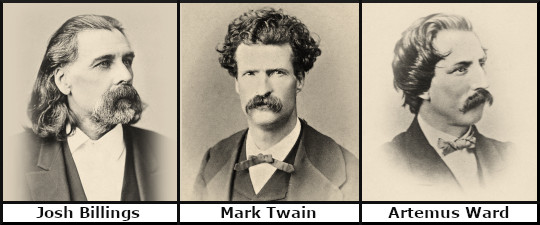
Image Notes: Public domain motion-picture show of Josh Billings (Henry Wheeler Shaw) from the Harvard Theatre Drove. Public domain picture of Mark Twain (Samuel Clemens) past Abdullah Frères circa 1867 from the Library of Congress. Public domain picture show of Artemus Ward (Charles Farrar Brown) from the Harvard Theatre Drove. Images accessed via Wikimedia Commons. Images take been resized, retouched, and cropped.
(Nifty thank you to Tom Beeler, Stephen Dorfman, Francis Neelon, Marcos Tatijewski, Simon Lancaster, Dick Plotz, Lane Greene, and George Dinwiddie whose inquiries led QI to codify this question and perform this exploration. Special thanks to boyfriend researchers Matt Seybold, Suzy Platt, Ralph Keyes, Fred R. Shapiro, Nigel Rees, and Barry Popik who have explored quotations in this family unit. Additional thanks to Lane Greene who pointed to the 1964 argument of Ronald Reagan and Dick Plotz who pointed to Walter Mondale's 1983 argument.)
Update History: On November 23, 2018 the November 1964 and the June 1983 citations were added.
Source: https://quoteinvestigator.com/2018/11/18/know-trouble/
0 Response to "Mark Twain What You Know That Aint So"
Post a Comment