Ming Dynasty Art and Literature 2 Hikers Mountain Town
Visit-briefing of the exhibition by Mael Bellec, principal curator at the Cernuschi museum.
This exceptional exhibition presents a set of more than ane hundred masterpieces of ancient Chinese painting. These paintings and calligraphies, exhibited in Europe for the first time, were born from the brushwork of the greatest masters of the Ming (1368-1644) and Qing (1644-1912) dynasties. Earlier being donated to the Hong Kong Museum of Art in 2018, these works were patiently collected by collector Ho Iu-kwong (1907-2006) who, according to Chinese tradition, gave them the name Chih Lo Lou , "the pavilion of perfect elation".
The Wu School was born at the finish of the 15th century in Suzhou (Wumen), a city rich thanks to the cultivation of rice and sericulture. The difficulty of careers in the second half of the Ming dynasty leads to a refusal of certain scholars to enter the assistants. In Suzhou, therefore, in that location is an intellectual aristocracy who will devote their time to research in the field of literature, painting and calligraphy. It should be noted that, traditionally, nosotros tend to consider that literate artists did non market place their works. We now know that about of these artists participated, in one manner or another, in commercial systems, sometimes disguised. The young Qian reading (1483), by Shen Zhou (1427-1509) is a deputed work which represents a young kid, considered a little prodigy, captivated in the study of the classics. In this vertical format, the foreground is occupied by a pocket-size building and two groves of trees with, backside, an empty space and in the groundwork of the mountainous reliefs. The foreground and the background are connected by the verticals of the trees. This type of limerick is very archetype at the time of the Yuan (1279-1368) and shows that all these artists of the Schoolhouse of Wu were inspired by their predecessors. The Confucian Preservation Pavilion (1491), also past Shen Zhou, is some other commissioned work.
| Young Qian Reading (Detail).1483. SHENZhou. Ink and colors on newspaper. 151,8 10 64,5cm. ©Hong Kong Museum of Art. | Solitary Contemplation in an Fall Grove (Detail). 1510. WEN Zhengming. Ink on paper. 66 x 29,2cm. ©Hong Kong Museum of Art. |
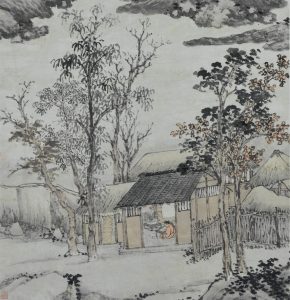
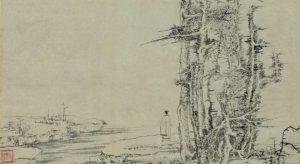
The School of Wu will redefine what literate painting is. This becomes in particular an platonic representation of the life of the scholar. The latter will for instance be represented practicing meditation, which becomes an imperative of personal and spiritual culture within the framework of a booming neo-Confucianism. In addition, scholars are cultured people and their painting becomes an art of art historian, which often refers to masters of the past. Wen Zhengming (1470-1559) is i of the most renowned scholars of the School of Wu, as much for his paintings every bit for his calligraphy or his verse. He deploys a great diverseness of styles and thus demonstrates that he perfectly masters part of the history of painting. Finally, literary painting can also be literary painting, which will be based on a text and illustrate it. Solitary contemplation in an autumn grove (1510), by the same creative person, evokes for the informed spectator the figure of the aboriginal poet Qu Yuan (339-278 BC NE) who committed suicide by throwing himself into a river. Wen Boren (1502-1575), is the nephew of Wen Zhengming, of whom he was a successor, but often in a more than picturesque style, with attention to detail. Instead of representing an isolated fisherman in communion with nature, Wen Boren instead describes the action of a group of fishermen in Fishermen recluse betwixt river and flowers (1570). Qiu Ying (1494-1552) was a professional painter who enjoyed great success and was appreciated by literate painters. The awakening of the dragon in spring draws on the way of court painting of the Southern Song (1127-1279).
Dong Qichang (1555-1636) is the personality who dominates the artistic scene at the end of the Ming dynasty, not only by his activity as a painter just also as a theoretician. As such, he prepare up frameworks of thought on what painting should be for the literate, frameworks that remained dominant until the twentieth century. Information technology is he who will dissever Chinese painting into two categories: craft painting (the Northern School) and literate painting (the Southern School). But the painters of the Southern School, whose lineage He traces back to Wang Wei (701-761), become legitimate models. Nosotros thus have an fine art of reference merely with a more than believing normative tendency than in the School of Wu. On the 3 fans depicting landscapes, nosotros can recognize different references. The one representing a pavilion placed on a promontory with a few trees, a second program occupied by a body of h2o and a few hills in the background is modeled on compositions by Ni Zan (1301-1374). On another fan, nosotros can find the very wet character of the painting of Dong Yuan (active 945-960) and the very pointillist way of Mi Fu (907-960). These references in no fashion prevent a share of originality or a specific style.
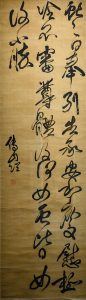
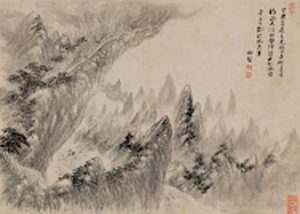
| The Awakening of the Dragon in Spring (Particular). Qiu Ying. Ink and colors on silk. 119,4 10 54,5cm. ©Hong Kong Museum of Art. | Forested mountains in the mist, in the manner of Mi Fu (Detail). ZHANG Hong. Ink and color on paper. 38,vii x 374,1 cm. | Excerpt from Wang Xianzhi's recovery letter in cursive calligraphy. FU Shan. Ink on silk. 158,6 10 45,8 cm. |
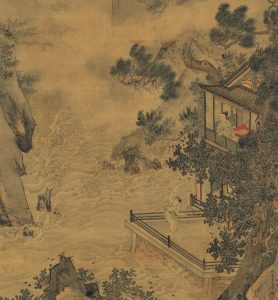
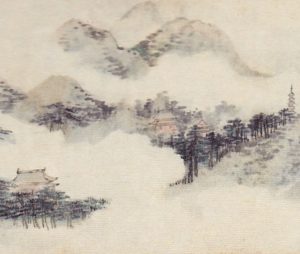
Lan Ying (1585-1604) drew much inspiration from the School of Wu but, as a commercial painter, adjusted his manner to the taste of his clientele every bit can exist seen in the series of twelve scrolls of landscapes on a golden groundwork. Each roll has an inscription that mentions the name of the work but also the reference to a painter. In particular, a landscape with a group of pavilions in the foreground and a much more airy composition than on the others is inspired past Ni Zan. This clever game of references allows the artist to demonstrate his knowledge and education in the field of painting merely will also satisfy the sponsors who will exist able to expect in the piece of work for reference to such and such a master. In Forested mountains in the mist, Mi Fu style, Zhang Hong (1577-1652) paints a misty panorama to illustrate a calligraphy by Dong Qichang. He explains in the text that "Dong Qichang particularly likes Mi Fu's mode, which he copied many times. In his works the clouds surround the mountains and the mists rising from the woods: he creates a vast and afar imaginary space... Mr. Bai asked me to paint a scroll on which was a poem past Dong (Qichang) in the wonderful style of Jin and Wei… And so I handled the brush like Mi Fu».
A traditional idea in Red china is that we run into the virtue of the artist through his work and this is even more true for calligraphers. Ho Iu-kwong collected calligraphy from artists he considered virtuous. Information technology should be remembered that the transition between the Ming dynasty and the Qing dynasty created questions for a certain number of scholars who had to cull between withdrawing or collaborating with the new dynasty. Our collector instead chose those he considered virtuous, ie those who opposed the new power.
There are many ways to appreciate calligraphy. We tin can brand a stylistic analysis of calligraphy. That of Fu Shan (1607-1684) is a good example. Fu Shan, a great intellectual from a family of scholars, refuses to serve the new rulers. He lives from the practice of medicine likewise as the sale of his paintings and calligraphy. Excerpt from Wang Xianzhi's recovery letter in cursive calligraphy, is an example of his art. While in his youth he admired and copied the works of Zhao Mengfu (1254-1322), after the fall of the Ming, he turned away from this master who had collaborated with the Mongol invader and henceforth referred to Yan Zhenqing (708-785) paragon of loyalty. Nosotros meet some echoes of this in the thickness of the lines used by Fu Shan. Some other way to auscultate a calligraphy is to look at information technology as a plastic composition, practically abstract. Poem in cursive calligraphy by Kuang Lu (1604-1650), another loyalist, allows usa to appreciate the composition thought out by the creative person earlier starting to paint: the central character, more than marked, serves as a pivot, while a character starting on the right is balanced, a little lower, by another that goes to the left. Finally, if you are a calligrapher yourself, you can follow the movements of the brush, the accelerations, the breaths of the performer and relive the realization of the piece of work, which allows you to perceive the personality of the artist. Verse form in semi-cursive calligraphy of Huang Daozhou (1585-1646), loyalist who will be executed, shows a powerful and flexible calligraphy, executed by means of precise but vigorous movements which evidence to his strong personality. Pines and rocks, past the same artist, attest to both the pictorial originality of the composition and the almost calligraphic treatment of the trees. A certain form of eccentricity was highly prized in the late Ming menses and this period is considered a fourth dimension of great originality in Chinese painting.
The troubles caused past the dynastic transition upset the lives of many painters. Huang Xiangjian (1607-1673), having lost contact with his family unit residing in Yunnan, following the fall of the Ming, undertakes a long journeying to notice them. Throughout his trip, he will accept notes, make sketches that will allow him to brand the anthology Voyage looking for my parents. In his annotations, he insists on the difficulties and the dangers of this trip and highlights the exceptional filial piety he showed. This album is very original because painted from elements taken on the spot and its compositions of landscapes are quite unusual. Some other approach to landscape can be literary. This is the case of the album by Gao Jian (1635-1713) which is entirely based on poems by Tao Qian (365-427). The first ii sheets refer to the history of The source of peach blossoms, symbol of a perfect society according to the platonic of scholars. The first places united states of america at the border of a stream lined with peach copse with a cave evoked in the background. The 2d shows an idyllic landscape of thatched cottages and fertile fields. The artist dispenses with the narration, contenting himself with evoking the story with a few simple motifs, considering all the spectators of his time know the story of this homo, who enters a cave, discovers an "earthly paradise" but, once out, never find it again.
| Travel in search of my parents. HUANG Xiangjian. Ink on paper. 26 x 31,5cm. ©Hong Kong Museum of Art. | Landscape in the manner of Huang Gongwang. Wang Shimin. Ink on paper. 103,vii ten 52cm. ©Hong Kong Museum of Art. | Landscape in the manner of Huang Gongwang. 1657. WANG Jian. Ink on gold paper. 108,ix x 53,5cm. ©Hong Kong Museum of Fine art. |
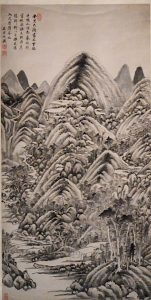
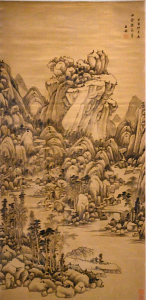
The iv Wangs are artists who brand the link betwixt the world of the Ming and that of the Qing. Wang Shimin (1592-1680), the most renowned of the 4 Wangs, will work to perpetuate the heritage of the Southern Schoolhouse by presenting himself as the legitimate heir of Dong Qichang. He specially appreciates the painting of Huang Gongwang (1269-1354), one of the 4 great Yuan masters. the Landscape in the style of Huang Gongwang is a adept example: the composition with the triangular shapes of the reliefs, the uninterrupted succession of superimposed mountains and the small peak plateaus evoke this predecessor. Yet Wang Shimin reinterprets the texture of the rocks in the pointillist manner of Mi Fu. In Mural in the manner of Huang Gongwang, Wang Jian (1609-1677) reinterprets a feature composition by Huang Gongwang. We find at that place the conical shapes of the mountains and the rocky plateaus merely the texture of the rocks is totally different and Wang Jian treats the different spaces separately, using dissimilar elements that he reassembles. Landscape in the manner of Huang Gongwang by Wang Yuanqi (1642-1715) proposes a denser composition and its construction passes from the foreground to the concluding in a sort of continuum. Wang Yuanqi, grandson of Wang Shimin, having successfully passed the exams, became a painter extremely appreciated by the Kangxi Emperor (1661-1722). This purple support will transform the style of the four Wangs into an almost official style of literate painting. The last of the iv Wangs, Wang Hui (1632-1717), was as well greatly inspired by all the one-time masters, but without distinction of school, and achieved a synthesis which became a new model of court painting.
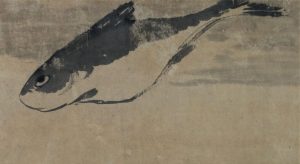
Bada Shanren (1626-1705) and Shitao (1642-1707), being from the royal Ming association, took refuge in Buddhist temples to escape purification during the conquest past the Qing. Bada Shanren is going to exist a monk chan for much of his life. He asserts a personal style in paintings of fish, plants, birds and, at the end of his life, landscapes. The scroll depicting a fish could be a reference to Ming loyalism and the ambiguity lies in whether information technology is a fish in h2o or a dead fish. Shitao tries to detect his place in the new society. In this context, he went to Beijing and received two orders from a loftier Manchurian dignitary, including O rchids and bamboos. This painting was fabricated in collaboration with Wang Hui (1632-1717) who is in charge of painting the rocks. The discreet signature of the latter suggests that the collaboration was not without difficulty. This attempt to bring Shitao into official circles will not be crowned with success. The four fruit and vegetable album sheets are, nevertheless, executed on paper from the imperial factories. They mix the "boneless" painting technique with that using contours. A dandy friend of Shitao, Huang Yanlü (1661-1725) undertakes a long journey and, on his return, the artist will etch an album illustrating his poems. The paintings represent real places but Shitao executes them from the texts and sometimes never went there. The works nowadays a wide multifariousness of styles, shine by their utilize of color every bit well every bit by the play on the organization of the texts.
| Fish. Bada Shanren. Ink on newspaper. 26x51cm. ©Hong Kong Museum of Art. | Countryside. After 1684. Bada Shanren. Ink on paper. 116,3 x 49cm. ©Hong Kong Museum of Art. |
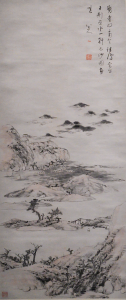
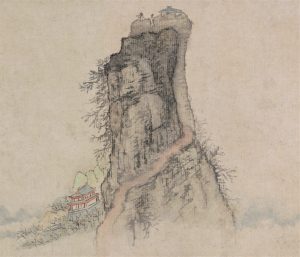
Shitao also creates from retentivity a painting entitled The Huang Mountains for a friend who wishes to visit this site. During the Ming flow, the Huang Mountains, a place of hiking, spiritual exercise or refuge for those who retired from political life, became a symbol in the eyes of scholars and loyalists. Many artists executed paintings referring to the Huang Mountains such as Hongren (1610-1664), or Mei Qing (1624-1697).
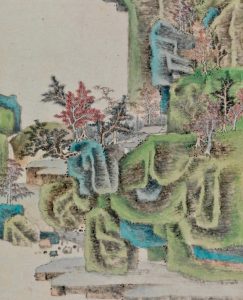
Xiao Yuncong (1596-1669) is an artist who stayed in Nanjing. The album sheets shown are influenced by Wen Zhengming simply the compositions and sharp outlines are probably related to his do of printmaking. Gazing at the trees in the distance by Zha Shibiao (1615-1697) refers to Ni Zan past the presence of reliefs and trees in the foreground but refers to Hongren for the peaks in the background. Gong Xian (1619-1689), originally from Nanjing, had to go into exile for twenty years after the sack of the metropolis by the Qing army. When he returns, he opens a school and lives poorly from his painting and his lessons but will refuse until the end to serve the empire. Young rushes and slender willows (1671) shows a very dense composition where the multiple passages of ink keys give an impression of volume and light, which could evoke a Western inspiration. It is known that Nanjing was a rear base of operations of the Jesuits and the spread of their prints influenced a number of Nanjing artists. Cheng Sui (1607-1692), refusing to serve the new power, retired to Nanjing where he lived as a hermit in a mount. Reading nether a tree in autumn is very representative of his style. The dots and pocket-sized lines spaced out past white are spread over the unabridged piece of work, crumbling the mural. This very original upshot is probably due to his mastery of engraving seals.
| Paintings after poems by Huang Yanlü (Detail). 1701-1702. SHITAO. Ink and colors on newspaper. 20,5 x 34cm. ©Hong Kong Museum of Art. | Landscape (Detail). 1645. XIAO Yuncong. Ink and colors on newspaper. 22,eight x xv,7cm. ©Hong Kong Museum of Art. | Young rushes and slender willows. 1671. GONG Xian. Ink on paper. 143 10 70cm. ©Hong Kong Museum of Fine art. |
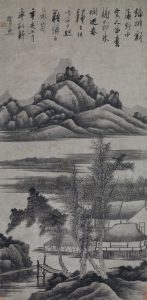
the 17rd century was a moment of groovy originality in Chinese painting, which greatly contributed to nourishing the enquiry of modern Chinese artists.
Source: https://amis-musee-cernuschi.org/en/peindre-hors-du-monde-moines-et-lettres-des-dynasties-ming-et-qing-collection-chih-lo-lou-2/
0 Response to "Ming Dynasty Art and Literature 2 Hikers Mountain Town"
Post a Comment